




Design of a Desktop Manual Assistive Device for Water Caltrop Shelling
Biological ecosystems are characterized by mutualism and interdependence. Take the water caltrop (Trapa bispinosa) as an example: it is not only a crop of high economic value but also provides a crucial breeding habitat for the pheasant-tailed jacana, a Class II protected species in Taiwan. However, the labor-intensive process of removing the hard shell of the water caltrop, coupled with an aging agricultural workforce and widespread labor shortages, has hindered efforts to scale up kernel production.
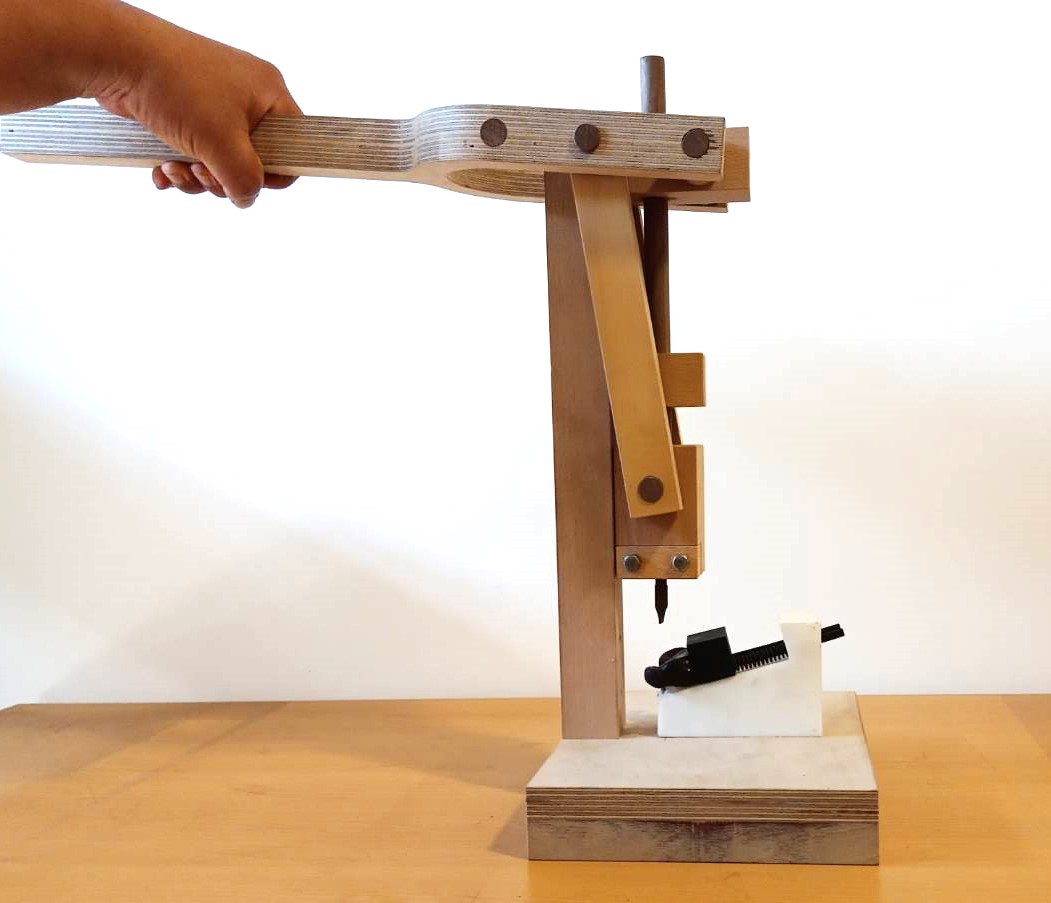
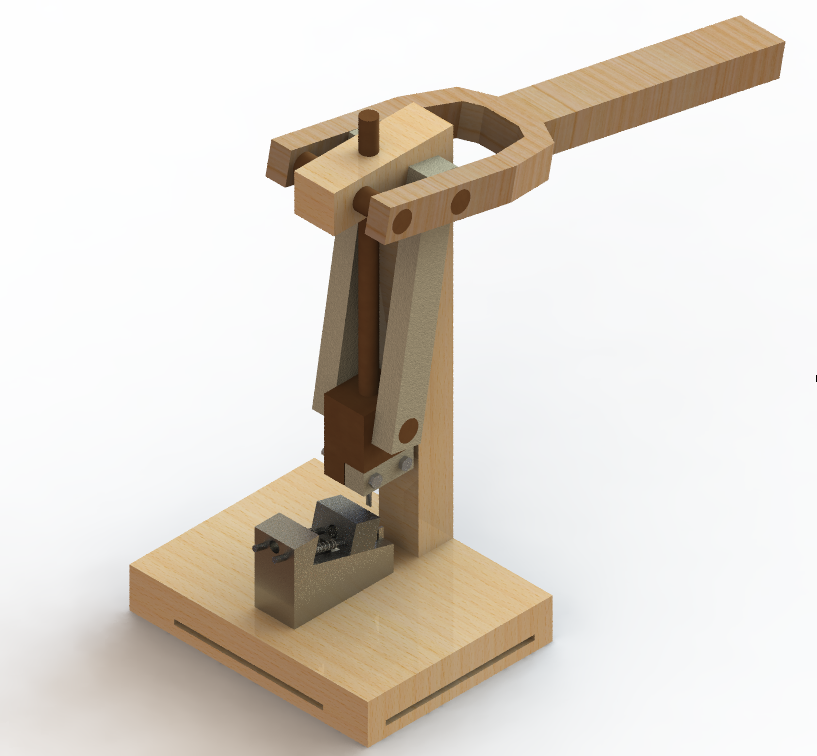
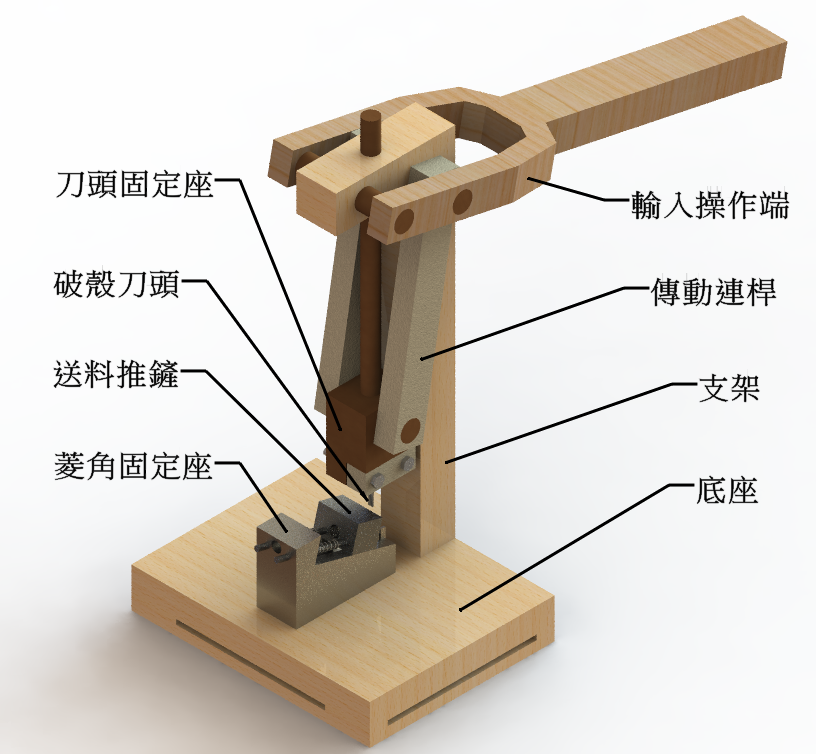
To address this challenge, our team has developed an assistive device designed to help elderly farmers efficiently remove the shells of water caltrops. This device incorporates ergonomic principles and utilizes a toggle mechanism to facilitate the initial shell-breaking cut. The design enables users to perform the subsequent peeling steps more easily, quickly, and with less physical strain.
By extending the working years of senior farmers and boosting the production of water caltrop kernels, this innovation not only enhances agricultural productivity but also encourages continued cultivation of water caltrop fields. In turn, this supports the preservation of habitats essential for the pheasant-tailed jacana, fostering a win-win scenario that promotes both ecological sustainability and economic resilience.
To address this challenge, our team has developed an assistive device designed to help elderly farmers efficiently remove the shells of water caltrops. This device incorporates ergonomic principles and utilizes a toggle mechanism to facilitate the initial shell-breaking cut. The design enables users to perform the subsequent peeling steps more easily, quickly, and with less physical strain.
By extending the working years of senior farmers and boosting the production of water caltrop kernels, this innovation not only enhances agricultural productivity but also encourages continued cultivation of water caltrop fields. In turn, this supports the preservation of habitats essential for the pheasant-tailed jacana, fostering a win-win scenario that promotes both ecological sustainability and economic resilience.
In the rural Guantian District of Tainan—Taiwan's premier water caltrop (Trapa spp.) production area, which accounts for approximately 70 percent of the nation's yield—these cultivated wetlands serve not only as a vital agricultural asset but also as indispensable breeding grounds for the vulnerable pheasant-tailed jacana (Hydrophasianus chirurgus), a Class II protected species.
Despite their ecological and economic significance, these fields face mounting challenges. The region’s farming population is aging sharply, leading to persistent labor shortages. Tasks such as manually removing the hard outer shell of the water caltrop—known as dehulling—are especially labor-intensive, causing physical strain and injuries in the shoulders, neck, and hands of elderly farmers. This ergonomic burden not only limits kernel production capacity but also discourages continued engagement in this arduous agricultural work, resulting in declining cultivation areas and threats to local jacana habitat.
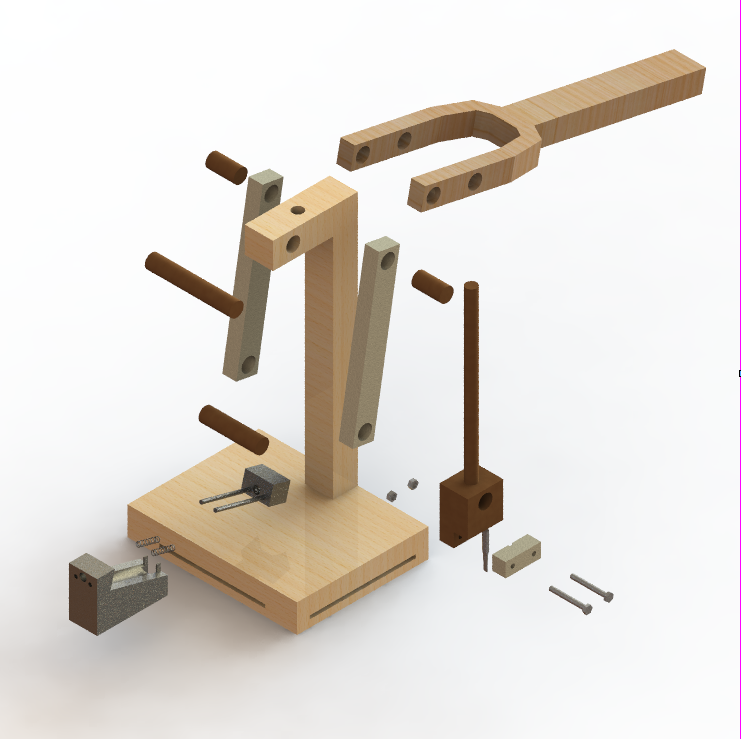
To address these twin crises—agricultural labor sustainability and ecological preservation—this study proposes the design of a Desktop Manual Assistive Device for Water Caltrop Shelling. The device is founded on ergonomic and biomechanical principles, integrating a toggle-like elbow mechanism to amplify applied force while optimizing user posture to minimize upper-limb strain.
Empirical observations and puncture testing were conducted to identify the structural weak points of the water caltrop shell—specifically, locations that facilitate an efficient initial penetration or “first cut,” which is critical for subsequent dehulling performance. These data informed the placement of the applied force in the device design. The lever-amplifying elbow mechanism concentrates the breaking force precisely at this weak point, while the ergonomically shaped handle and device geometry ensure comfortable and low-stress operation.
Prototype testing and laboratory simulations confirmed that this assistive tool significantly reduces the physical effort required for shell removal, thereby extending the working capabilities of elderly farmers. By preserving their productive years, the device supports sustained water caltrop cultivation and, in turn, maintains the vital wetland habitat needed by the pheasant-tailed jacana. This approach creates a harmonious synergy between ecological conservation and rural economic stability—anchored in a human-centered design that benefits both older farmers and a protected wetland species.
Despite their ecological and economic significance, these fields face mounting challenges. The region’s farming population is aging sharply, leading to persistent labor shortages. Tasks such as manually removing the hard outer shell of the water caltrop—known as dehulling—are especially labor-intensive, causing physical strain and injuries in the shoulders, neck, and hands of elderly farmers. This ergonomic burden not only limits kernel production capacity but also discourages continued engagement in this arduous agricultural work, resulting in declining cultivation areas and threats to local jacana habitat.
To address these twin crises—agricultural labor sustainability and ecological preservation—this study proposes the design of a Desktop Manual Assistive Device for Water Caltrop Shelling. The device is founded on ergonomic and biomechanical principles, integrating a toggle-like elbow mechanism to amplify applied force while optimizing user posture to minimize upper-limb strain.
Empirical observations and puncture testing were conducted to identify the structural weak points of the water caltrop shell—specifically, locations that facilitate an efficient initial penetration or “first cut,” which is critical for subsequent dehulling performance. These data informed the placement of the applied force in the device design. The lever-amplifying elbow mechanism concentrates the breaking force precisely at this weak point, while the ergonomically shaped handle and device geometry ensure comfortable and low-stress operation.
Prototype testing and laboratory simulations confirmed that this assistive tool significantly reduces the physical effort required for shell removal, thereby extending the working capabilities of elderly farmers. By preserving their productive years, the device supports sustained water caltrop cultivation and, in turn, maintains the vital wetland habitat needed by the pheasant-tailed jacana. This approach creates a harmonious synergy between ecological conservation and rural economic stability—anchored in a human-centered design that benefits both older farmers and a protected wetland species.