



Electric agricultural machinery saves energy, reduces carbon emissions, and undergoes upgraded management, enabling the agricultural industry to move towards technological advancement.
Electric agricultural machinery conserves energy and reduces carbon emissions.
Climate change has recently received significant attention, and countries around the world have set clear carbon reduction goals, with sustainable agriculture gaining prominence. Traditional agricultural machinery, mostly powered by diesel, is one of the primary sources of carbon emissions in agriculture. To respond to the call for net-zero emissions, countries are encouraging farmers to use electric agricultural machinery that reduces carbon emissions. Electric agricultural machinery also offers advantages such as low noise, low vibration, low waste heat, and easy startup. If they can be charged with renewable energy sources like solar power or wind power, it further enhances energy savings and carbon reduction efforts.
Electric agricultural machinery addresses the issue of labor shortage in agriculture.
In the face of challenges such as aging farmers, declining birth rates, and labor shortages in agriculture, the evolution of agricultural machinery has followed suit by incorporating industrial technology to enhance agricultural equipment. This shift aims to reduce labor and effort while embracing electrification. Additionally, the integration of artificial intelligence and unmanned drone technology allows for diverse control of agricultural machinery, promoting agricultural advancement. This assists farmers in addressing field management issues and maximizing profits.
The current development of electric agricultural machinery in Taiwan is as follows.
Department of Smart and Quality Agriculture, MingDao University
Under the Agricultural Development and Extension Agency (ADEA) of Taiwan's Council of Agriculture, the "Agricultural Machinery Sharing Program" has been implemented. It is the only program in Taiwan that establishes agricultural machinery rental stations to provide electric agricultural machinery for farmers to use. By adopting a rental-based service model, the program aims to promote the concept of sharing economy and sustainable agriculture, emphasizing "renting" instead of "buying" and "using" instead of "owning." Through the efforts of the Council of Agriculture, this program will be expanded to various regions nationwide.
YU NUNG AGRICULTURAL MACHINE FACTORY CO.,LTD.
In response to the demand for agricultural mechanization, self-developed transplanting machines and cultivators have been created. The successful development of small gasoline engines marked a departure from the market dominance of Japanese engines. Taiwan's domestically produced agricultural machinery achieved the highest records in both domestic and international sales. Additionally, Taiwan became the exclusive distributor of "tractors" from JOHN DEERE, the world's oldest and most renowned company in the field, and obtained the top position in terms of sales growth rate in the Asian tractor market.
DROXO Technology Co.,Ltd.
Starting as an entrepreneurial venture in the field of unmanned aerial vehicle (UAV) technology, the company entered the agricultural UAV market. This includes various types of spraying drones and crop health multispectral detection. They have quickly commercialized these technologies and continuously adapted to customer demands. Their ongoing research and development focus on integrating various sensing devices, mechanism design, and automation assistance features. Currently, their product range has expanded from UAVs to large tank-mounted intelligent vehicles and greenhouse automated spraying vehicles.
GOODKYM TECHNOLOGY CO.
They are dedicated to innovative research and have launched various environmentally-friendly and agriculture-specific machinery. Their product, the "Dedicated Wood Chipper for Organic Fertilizer," is designed to shred tree trunks and branches into granular organic fertilizer. The crushing process effectively eliminates parasites and their eggs, significantly reducing pest problems associated with piled branches. This achieves environmental benefits. Their "Rapid Fermentation Machine for Organic Fertilizer" efficiently processes agricultural waste, with a short production time, saving time and electricity. It is environmentally friendly, does not breed mosquitoes, does not generate foul odors, and can be set for automatic turning and ventilation.
E Co., Ltd./NICHINO
The company is primarily engaged in the manufacturing, sales, and maintenance of agricultural machinery. Their own brand, "Rinong," specializes in the production of inter-row cultivators. These machines are designed and manufactured to meet the specific planting methods and crop requirements of customers, providing a comprehensive solution from design to production. All their products have passed the performance testing of the Council of Agriculture and are certified by TÜV Rheinland, Germany. Some products have also obtained CE certification for the European market. They are marketed in more than twenty countries.
Other News
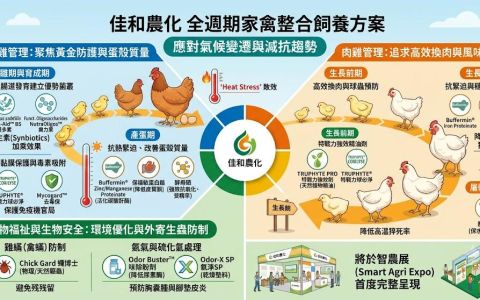
As global climate change intensifies, "heat stress" triggered by high summer temperatures has become a core challenge for the poultry farming industry. Meanwhile, under the dual trends of animal-friendly farming and antibiotic reduction, improving poultry immunity and gut health through precision nutrition has become key to maintaining production efficiency. In response, Jiahe Agrochemical Co., Ltd. (hereafter referred to as Jiahe Agrochemical) has proposed a full-cycle integrated feeding management solution tailored to the distinct physiological needs of layers and broilers, covering the "brooding period, mid-laying/growing stage, and environmental management.
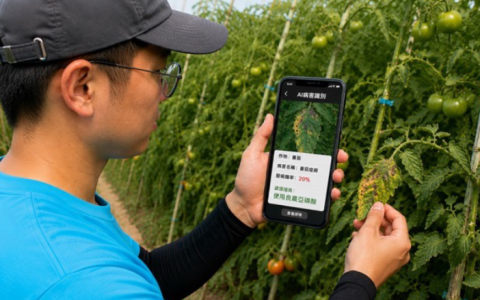
With Taiwan's agriculture facing multiple challenges such as an aging population, laborshortages, and climate change, how to effectively pass on the years of field experience accumulated by veteran farmers and combine it with emerging technologies to improve management efficiency has become an important issue for agricultural development. Agro-Green International Co Ltd stated that the future of agriculture not only requires experience,but also data analysis and smart technology to assist decision-making, creating a new generation of management models that combine inheritance and innovation.
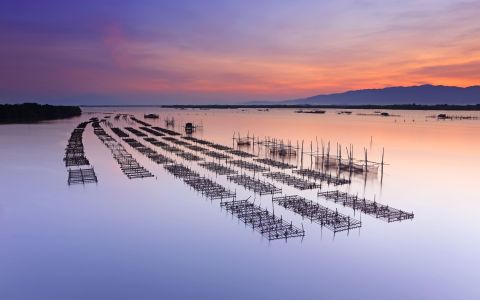
By 2026, the Asia-Pacific region will have reached a historical tipping point in food security. Faced with climate volatility and supply chain disruptions, regional powers are shifting from traditional farming to high-capital, high-tech intensive aquaculture.

Datuk Seri Arthur Joseph Kurup says sustainable soil management is key to tackling urbanisation and climate threats, with RM120 million allocated for soil restoration.
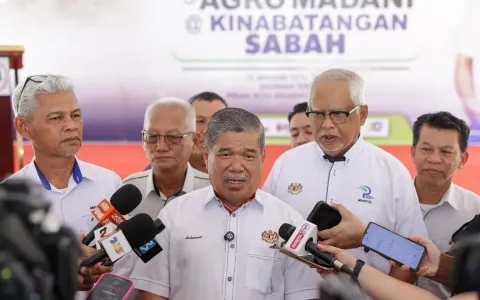
Malaysia aims to boost its ruminant livestock self-sufficiency rate from 20% to 50% by 2030 through new agri-food programmes and modern farming projects.
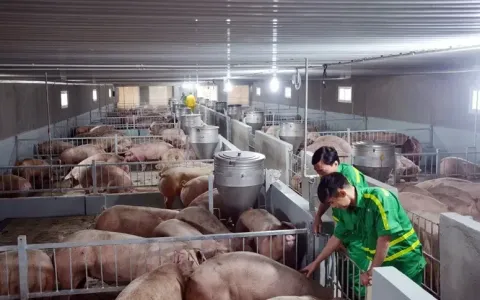
Vietnam's livestock industry is facing significant fluctuations in the first quarter of 2025. Pork prices have risen unusually high, contrary to the trend of previous years. While the livestock population remains relatively stable, poultry and egg prices have fallen sharply.
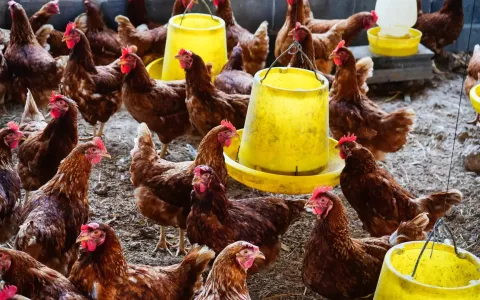
Vietnam’s livestock sector is accelerating restructuring, reducing production costs, and developing a fully integrated supply chain.
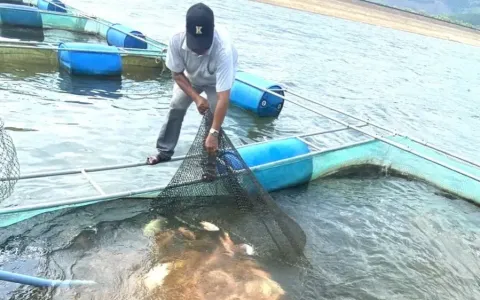
(GLO) - In the context of the fisheries sector's push for green transformation, agricultural extension work is not limited to technology transfer but also plays a role in connecting value chains and guiding sustainable production from the grassroots level.

These projects focus on high-tech aquaculture, vegetable and flower cultivation, livestock farming, and slaughter operations.
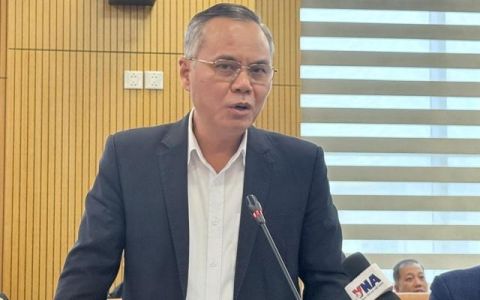
As Việt Nam’s livestock sector faces the need to renew its growth model, enhance added value and fulfil its sustainable development commitments, Deputy Director of the Department of Livestock Production and Animal Health Phạm Kim Đăng spoke to Việt Nam News reporter Trần Như about the sector’s key orientations and solutions for 2026.